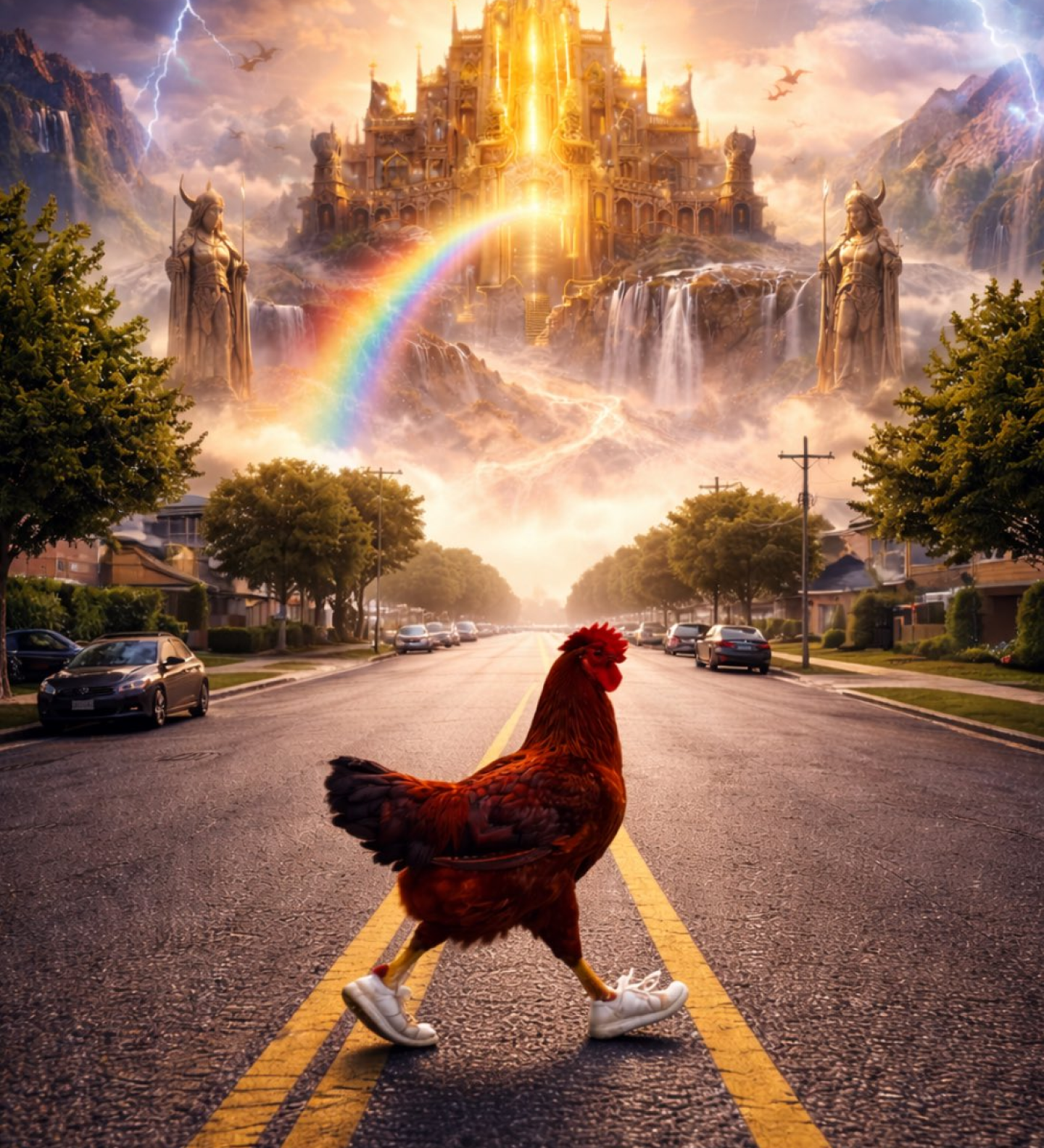

Just crossing the road
CA:
B7ToIJNKQoFaPgRLZMeGvT9xZb9HLdVdKUNSBQoSPUMP


Just crossing the road
Before the internet.
Before markets.
Before anyone pretended to understand irony.
There was a road.
And there was a chicken.
And someone, at some point, asked the question that never went away.
Why did the chicken cross the road?
Not how.
Not when.
Not whether it should.
Why.
The question mattered because it assumed intent.
It assumed choice.
It assumed that even the most ordinary creature might have a reason for stepping into danger.
The question did not begin as a punchline.
In the mid-19th century, it appeared in Knickerbocker Magazine with no flourish and no explanation. A simple riddle. A plain answer.
"To get to the other side."
No clever twist.
No moral lesson.
No apology.
That restraint is why it survived.
People expected more.
They leaned forward, waiting for wit, for wordplay, for surprise.
Instead, they were given the truth.
The humor wasn't in the answer.
It was in the refusal to entertain expectation.
The joke didn't perform.
It withstood.
This was anti-humor before anti-humor had a name.
The OG first meme.
Over time, a darker interpretation emerged.
"The other side" wasn't just a place across the road.
It was a phrase people used for what comes after.
Roads were dangerous.
Chickens were fragile.
Some heard the answer and laughed.
Others heard it and paused.
The joke allowed both reactions.
It never clarified.
It never corrected.
That ambiguity became part of the lore.
The question spread because it could be bent without breaking.
Children turned it into traps.
Adults turned it into philosophy.
Satirists, skeptics, teachers, cynics, and comedians all took their turn answering it.
It crossed languages.
It crossed cultures.
It crossed generations.
The chicken adapted.
Not a hero.
Not a god.
Not a symbol of strength.
A chicken.
Ordinary.
Anxious.
Unremarkable.
Which made the crossing feel familiar.
The story worked because the chicken wasn't special.
It was anyone.
Eventually, everyone knew the answer.
Which made asking the question again the point.
It became shorthand for inevitability.
For obvious outcomes.
For movement that didn't need justification.
The joke stopped being about humor.
It became about recognition.
The chicken didn't cross the road once.
It crosses every time someone chooses movement over comfort.
Every time risk outweighs safety.
Every time a line is stepped over because staying put feels worse.
Cycles repeat.
Roads reappear.
The question returns.
This is not a story about a chicken.
It's a story about crossing.
The joke survived because it was never finished.
It never told you what to think.
It only asked if you were paying attention.
The road is still there.
The chicken is still walking.
And the question is still being asked